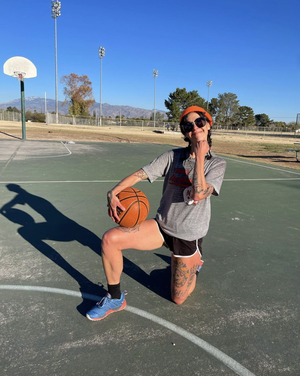
Valentine - Stripper
July 21, 2025
Valentine is a force. At the strip club she has a sexy confidence that paws across the rack. She slows down time making it impossible to look anywhere else but watch her strut and swing and hoist and flip. Her style reads as girl next door with tattoos. When she’s not at the club she is probably blowing your mind with
Colorful, joyful, sporty outfits come to mind when I think about Shelby, which makes the fact that her day job requires a monotone look all the more interesting. She was at the fire station when we spoke. We covered some intriguing ground before our conversation that was cut off by what else, the call of duty.
Below is a condensed and lightly edited version of the in-person conversation with the one and only Valentine.
Will you start us off by giving an overview of what uniforms a firefighter wears?
The public is probably most familiar with our duty uniform, the navy-blue t-shirt with black belt, navy pants, and steel toe black leather boots.
What about your fancy uniforms?
Ok so we have three uniforms. The duty uniform and our Class A and Class B uniforms.
Class A is the one you would wear at a gravesite; it’s a suit essentially. Our formal uniform would be Class B which is the polyester dress pants, the patent leather shoes, and a formal button-down shirt. We moved away from a light blue to a very dark navy shirt, which I think looks better. It has our patches on the side representing our fire department and then we have our nameplate with years of service, and collar brass.
Oh, and there is a cap for the Class A uniform and no hat for Class B uniform.
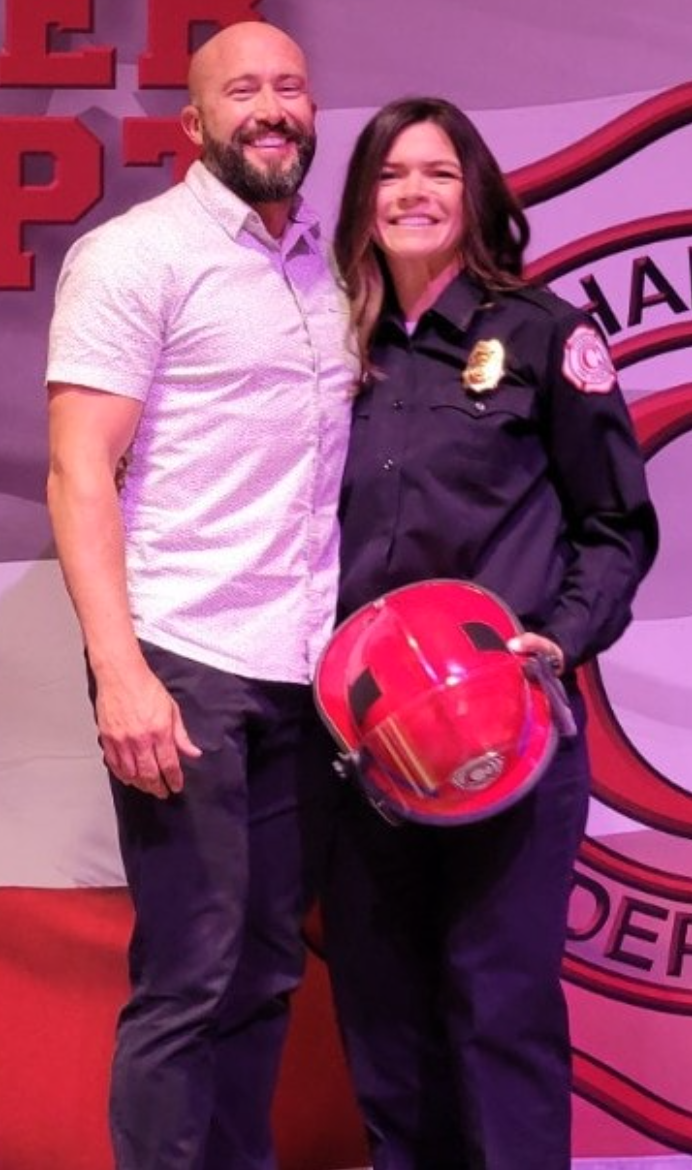
Shelby, and her husband, Jeffrey, at her promotion ceremony to Captain
What do the collar pins, or brass, mean?
Our hardware dictates rank. Silver is at the officer level and for our firefighters. Now that I am a captain I went from my cute silver badge to a gold. I wear bugles on my shirt collar which also signifies my rank. The bugles go back in history to horse and carriage times when the captains had actual bugles they could use to signify certain direction to the fireground. I like that cool piece of history.
Most of the time, though, you’re in the duty uniform, is that right?
That’s right. We have to follow NFPA standards [National Fire Protection Association], which tells us what materials things can be made of. We wear a lot of cotton so when we’re on a call the material isn’t melting and our clothes are able to withstand higher heat.
How many of those duty uniform t-shirts do you have?
You can get as many of those as you want. Every year we are given a uniform allowance and there is an online store that has everything we are approved to buy. I have four or five short sleeve shirts, a couple long sleeve polos, four pairs of pants, six pairs of PT shorts, hats, beanies, jackets, sweatshirts
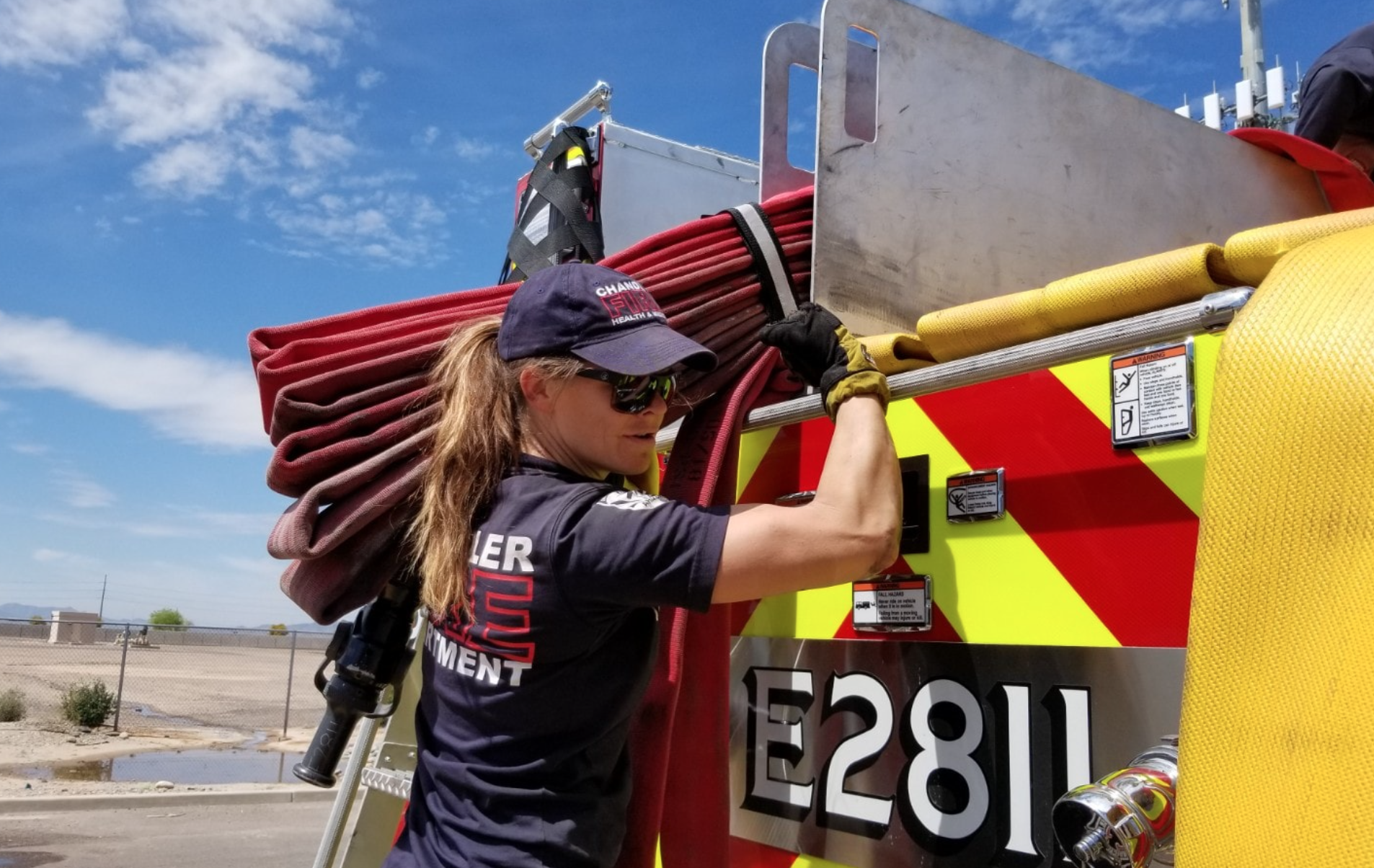
Shelby flexing her duty uniform
Are there styles specific for women, or is it all based on men’s cuts and sizing?
Over the course of time, there’s options. There used to be only two cuts for women’s pants where men had three or four options. But now they also have various women cut shirts. But yeah, options. If you are a person with a wider torso or midsection there is a style of shirt for that person versus the guy that is 6’4” and needs the longest shirt possible.
Wait, there is another uniform we didn’t cover – your hero outfit – what do you wear on calls?
The turnout! Yes, all the shows that you watch, all those Halloween costumes that is the turnout. So the turnout is that big jacket and pants, fire boots, hood, helmet, gloves, and then our fire packs with our SCBA [self-contained breathing apparatus].
What’s the process for jumping into them when the alarm sounds for a call?
Any fire call means we need to be turned out and buckled in and rolling within a minute and a half. It’s a muscle memory thing because we can’t plan when emergencies are so it’s something that we practice a lot to get those turnout times as quick as possible. My process goes like this: picture my pants kind of swept over my boots. I pick up my hood first throw that on, step into my boots through my pants, grab the sides of my suspenders, pull those up in one motion getting my arms in there and then I grab my jacket, throw that on, zip that up and then hope into the cab. Our SCBAs are in our trucks. We do not wear our helmets in the truck because if we were to get in an accident with a helmet on that’s probably going to be some fun neck or head injury.
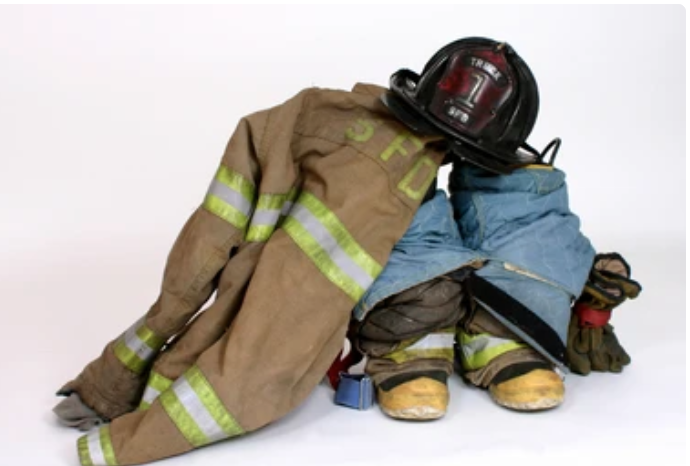
Example of turnouts ready to be stepped into
Are the turnouts heavy?
Not so much the turnouts as it is the SCBA and sometimes the gear that you carry in your pockets can be a little bit cumbersome and heavy, or your tools. It depends what you like or what you need to do or what structure you’re trying to get into. All in all I mean, you’ve got up to 70 pounds on you.
What does all of that do to your range of motion?
Mobility is restricted because you’re in a bulky outfit. You have a helmet on, your vision could be a little bit restricted by your SCBA, you’ve gotta be looking in one direction, your peripheral is kind of minimized. But then that air pack on your back – if you’re in a tight house or hallway or there’s another firefighter next to you everything is taking up room. But that bulk plays an important role. You don’t want form-fitting turnouts because that’s just going to make it easier for heat to get to you.
What is the technology behind the turnouts?
They are made up of three layers – an outer shell, a moisture barrier, and thermal barrier. The outer shell is non-flammable, the middle layer keeps steam or hot anything from penetrating, and the thermal barrier has air pockets. Firefighters always say “we will always risk a lot to save a lot”. If we know there’s people inside to go get, we are going to go get them. With our turnouts, over time there have been improvements made with their quality and it’s allowed us to get into situations or environments that our predecessors and former guys weren’t able to.
What’s something interesting the general public might not know about your uniforms?
The color of our helmets and their reflectors all have specific meaning. Firefighters will have a yellow helmet with yellow reflectors. Paramedic firefighters have yellow helmets and blue reflectors. Captains will have red helmets, and a red helmet with blue reflectors means ALS [advanced life support] or paramedic level. Chiefs have white helmets. Safety officers wear green helmets. The visual is helpful when I’m on scene I know who’s in charge and what people we are working with.
How does the public respond to you when you’re in uniform versus when you’re not?
What is your personal style? How would you define it?
My personal style is laid back and that’s also how I define it. Depending on the season I usually go with some sort of tight legging with a baggy shirt. Then over the last decade I have discovered hats and so I will throw on a hat and it’s just one of those fun super casual outfits, but it’s not disheveled- there’s always thought behind it.
What about hair and makeup?
I am a low maintenance lady. Most days my makeup consists of brows and maybe a little bit of concealer to smooth everything out and tone it. I feel comfortable and confident walking out the door with just a little bit of makeup. For my hair I wash it and let it air dry. I get my hair done about once a year so I just make sure it looks good grown out. I stick with more of a natural, effortless look because I want to be comfortable – I’m doing stuff all day.
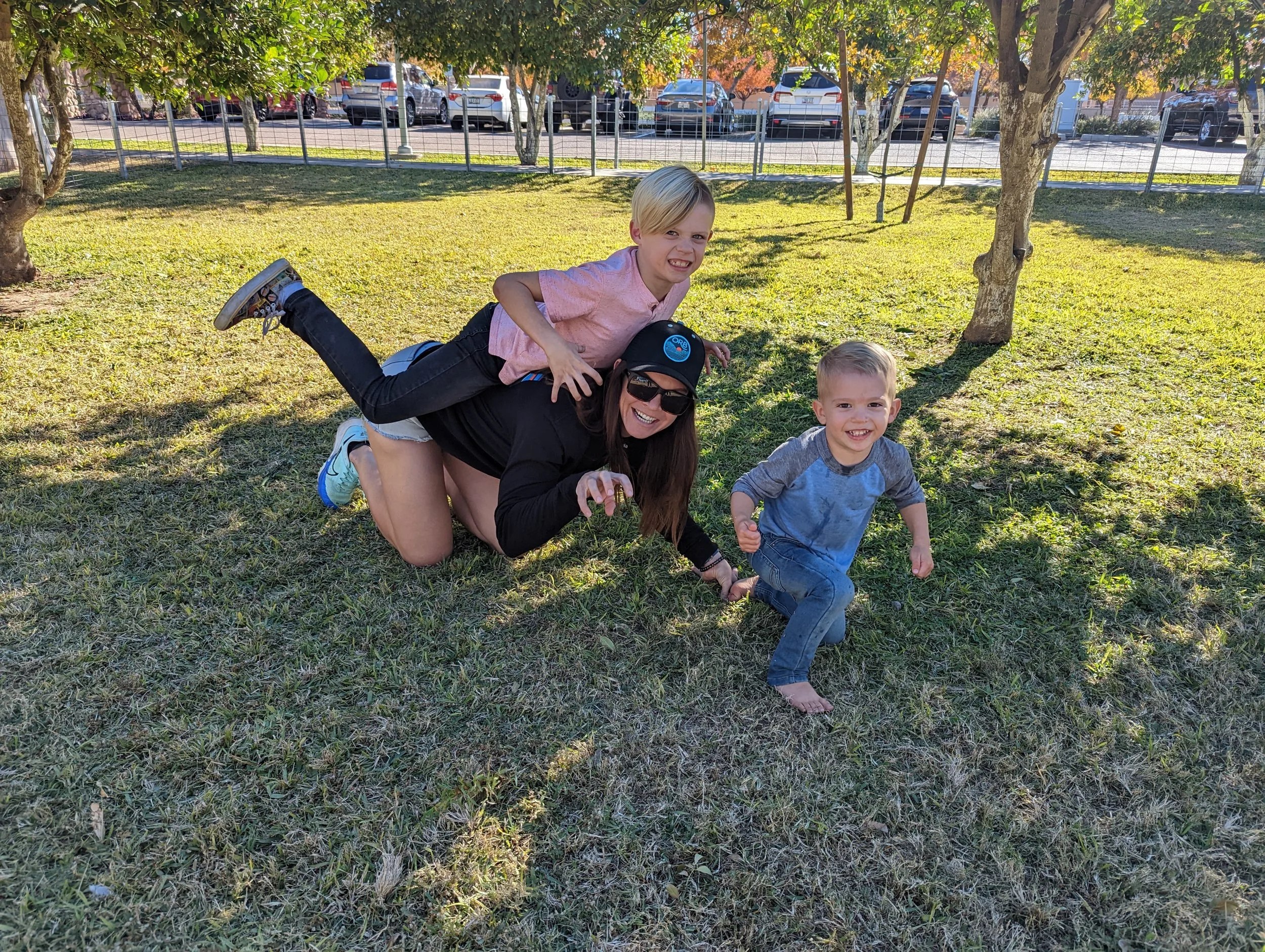
Shelby hanging out with her two boys, being casual, cute, and supermom